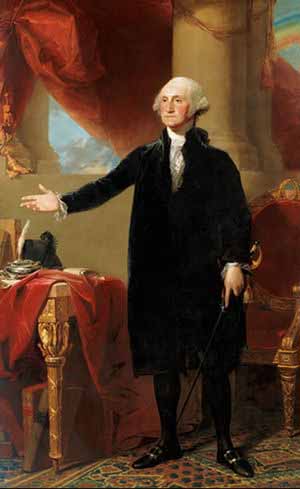
It’s been awhile since my last post of modesty, and I have to apologize for the delay. Between birthdays, work trips, and a move to a new apartment life has been kind of hectic recently. But now I am set up with internet in my new apartment, and I’m ready not only to announce a new post, but a new SERIES of posts. Today begins the American Presidents series. Since I just moved to Virginia, George Washington seems even more appropriate to start with. Especially since I already posted about the pre-first President, Mr. Hansen from Maryland. Without further delay…
The Father of Our Country
George Washington was born on February 22, 1732 near Colonial Beach, VA. Educated at home, Washington worked as a surveyor for his first career, not including his help around the family farm. While many may have read that this was the youthful Washington’s early career, most don’t realize what a tremendous impact this had on his effectiveness as future general due to his unique knowledge of the terrain of the land. Another little known fact is that Washington’s one and only trip outside the United States was in 1751 to Barbados in hopes of curing his half-brother of tuberculosis. His half-brother died the following year, leaving Washington the owner of his first estate, Mount Vernon. During this time, Washington also joined the militia as a Major and also expanded his estates around Mount Vernon and in the Ohio territory.
In 1754, Washington suffered his only military surrender at Fort Necessity where he was defeated by the French Canadians and their Indian allies during the Seven Years War. After the French and Indian War, Washington retired as a Brigadier General to his farm as a tobacco farmer and local politician. In 1759, Washington married Mary Custis, from which he inherited additional lands and wealth that made him one of the richest and most successful men in Virginia. Into the marriage, Martha brought her children, and eventually grandchildren, from a previous marriage who were Washington’s only heirs. It is believed that Washington’s earlier fight with smallpox may have made him sterile.
In the 1770s Washington began to become more political, sending letters suggesting a boycott of English goods until certain taxes were repealed. He attended the First Continental Congress as a delegate from Virginia, and was from there elected as the commander-in-chief of the Continental Army. Washington’s greatest asset as general was his ability to raise the ever-fleeting morale of the army even during the most desperate of times when his soldiers resorted to eating dogs and starving for days during harsh winters.

The most notable of these instances was Washington’s successful Battle of Trenton on Christmas Eve 1776. After a series of degrading losses, Washington rallied his army to cross the Delaware River and take the British by surprise. This was followed by the battle of Saratoga, where Washington successfully enlisted the support of the French, who ultimately helped us win the war. But without going into much more detail, we won. Yay independence!
After the war, Washington resigned his command, and again retired to Mount Vernon. Another not-so-widely-known fact is that Washington became quite the successful businessman and farmer. Mount Vernon was very successful after Washington changed the main cash crop from tobacco to wheat. His entire life, Washington was very self-conscious of his image and ensuring his legacy, a point made well by Joseph Ellis in his book His Excellency: George Washington.
In 1787, Washington was summoned out of retirement to preside over the Constitutional Convention to revamp (get rid of) the Articles of Confederation. Washington was the only figure at the time (short of maybe Ben Franklin) who could bring legitimacy to the proceedings, and he was chosen unanimously by the Electoral College to be the nation’s first President. Washington’s two terms as Commander-in-Chief set many precedents that we respect today, such as the two-term limit, using the term “Mr. President,” and the utilization of an executive cabinet of advisors. During his later years, including his eight years as President, Washington’s health was mired by constant toothaches that caused him immense pain. Contrary to popular belief, Washington did NOT have wooden teeth. Fake teeth at this time were made from ivory mostly, but also using human teeth of slaves who were given special privileges for “donating” their teeth.
After his two terms as President, Washington AGAIN retired to Mount Vernon to manage his estate and live out his life with Martha. In his last year of life, 1798, President John Adams commissioned Washington to be the General of the armies that were being raised for a potential war with France, but his service was largely symbolic and Alexander Hamilton served as the physical general present. Washington died on December 14, 1799 at Mount Vernon where he is buried today.

Washington’s legacy is like none other in American history. Very rarely are Washington’s shortfalls and negative attributes discussed or even known. In fact, on the ceiling of the Capitol rotunda is a painting entitled, The Apotheosis of Washington, which shows Washington being raised up to Heaven and being made a god. Probably won’t find that depiction of any other figure in our history. Washington is on the one-dollar bill, the 25-cent coin, Mount Rushmore, 11 universities carry his name, our nation’s capital is named for him, 1 state, 30 counties, and over 250 towns, townships, and cities are as well. There is even a statue of Washington in Trafalgar Square, London. He’s kind of a big deal.
Next up, John Adams. (I promise after the first few presidents, the posts will get shorter)

