Search This Blog

Saturday, March 27, 2010

Some history you may not know


Today marks the 24th anniversary of a great day in world history where one of the world’s most passionate, and unknown figures was born. He is a man of obscurity except to a limited number of facebook friends, but his influence ranges from Meadowcroft Lane to Harrisonburg to Scotland to Washington, D.C. Ladies and gentlemen, here is the history of my life…

Who am I?

Lee Brooks was born on March 27, 1986 in Rockville, MD at approximately 7:57pm. He was the first child to Joe and Paula Brooks, but was later joined by Robert Brooks 3 years later. Lee grew up with a small play group, and attended the exhilarating and memorable Camp Tiny Feet in the summers of 1990-1992. Lee and his neighbor Stefan, first formed the Meadowcroft Lane Gang around this time. This group would be expanded on the high school volleyball court later on. A product of the public school system, Lee attended local schools in the area, having never moved during his 24 years of life (except during college).

As he grew up, Lee had many aspirations of what he wanted to be when he grew up (none of which was a congressional staffer, even though he loves where he is now). They ranged from an astronaut, to a movie director, to an archaeologist, and of course every kid’s dream, POTUS. In high school, Lee played JV football, boys and coed volleyball, and served in SGA. He carried this SGA experience on with him to James Madison University, where he joined the centennial class and served in the organization all 4 years. Lee kept himself busy in college joining many organizations and keeping a challenging class schedule, with such classes as GKIN100: Walking and Jogging.

Upon graduation, he ventured across the Atlantic to attend the University of St. Andrews to complete a master’s degree in ancient history. Lee loves the Romans, and old walls. During this time, he traveled extensively throughout Europe and Turkey. After finishing the program, he came back to the New World in America to look for a job, and took an unpaid internship on Capitol Hill. The stars were in alignment, and after a few months of working for free, he was hired full-time. This is where Lee has been ever since. As a lifelong resident of the DC metro area, Lee loves the city more than any other, and in general thinks life is pretty awesome.

In the past, Lee’s birthdays have been held at Chuck E Cheese, Discovery Zone, his backyard, Garber Hall at JMU, Westport Village, and the St. Andrews Deans Court Common Room. His favorite color is blue, navy blue to be specific. He loves watching quality movies, reading about history, drinking beer out of a straw on occasion, spending time with the wandering blonde wine o, a good cigar every now and then, and just like every guy, he loves long walks on the beach at sunset. His life can pretty much be summed up and understood through John Mayer lyrics depending on the day. His favorite foods are sushi, pasta, nachos, and ranch dressing. He has a miniature dachshund named Fritz.

Well that is a glimpse into the life of one of histories most forgotten figures. Enjoy your weekend!

Tuesday, March 23, 2010

The Lost City


So I missed a lot of events last week: Ides of March, James Madison’s birthday, St. Patrick’s Day… I apologize. Today’s post is a special request from a special fan…

Atlantis: No, not the Resort

Everyone’s heard stories about the mysterious island that existed thousands of years ago, and boasted some of the most advanced technology and greatest leaders of ancient times. Then, all of a sudden, it vanished. The island sunk supposedly? A natural disaster wiped out the entire population? Where did this fairy tale story come from? I feel sort of like the History Channel with this post because I’m writing about a conspiracy theory, and while this story does not include aliens (at least in my version) I’ll try to give you some facts and some myths.

The first mention of Atlantis is by Plato in his Timaeus and Critias. He mentions that it was a great civilization that conquered North Africa and much of the Mediterranean roughly around 9600 B.C. FYI, ancient Egypt flourished around 3000-1000 B.C., ancient Greece had its high point from 500-200 B.C. (Plato was writing in 355 B.C.), and Rome ruled the Mediterranean and most of Europe from 200 B.C. – 400 A.D., so this was theoretically MUCH earlier. The civilization was supposed to have been unrivaled in technology and grandeur until Plato’s time, or even after his time. As the story goes, Atlantis was founded by well-intentioned, smart men who expanded the civilization to dominate the Mediterranean. Over time though, the leaders became greedy and power-hungry. Poseidon thus decided to erase their existence. And just like Emeril, BAM, they’re gone.

It is unclear whether Plato meant this mystical story to be an allegory for what would happen to civilizations who the gods looked down upon, or if he had some factual basis for an island that was destroyed before recorded history even began. As most tradition was carried orally until the Egyptians, and really the Greeks, it is possible that there may have been some factual basis for his tale. However, let’s be honest, it sounds like a Plato parable to teach a lesson combined with a good bed time story. Other evidence that he is speaking from fact is that he repeats several times that this is “history” he is telling, whereas in other parables, like the Cave, he makes it clear that he is telling this to prove a point. Adding on to the “he said she said,” it is recorded much later that Aristotle, Plato’s student, claimed that Plato made up the parable for moralistic reasons. Who knows. Aristotle also went on to disagree with much of what his teacher wrote.

Several locations have been claimed for the island as well, and almost all of these have been “backed up” (in the loosest sense of the word) with archaeological discoveries and underground photographs. Some claim the island was in the Caribbean, some say it was in the middle of the Atlantic Ocean giving the ocean its name, others say in the Mediterranean, and some say it was in the Indian Ocean. For logistical reasons, the most likely location was in the Mediterranean, seeing as this was the only part of the known world at the time. There are also theories that the Atlantians dispersed through Africa, Europe, and even South America and that’s why we find similar stone structures, specifically pyramids, in those locations. Highly doubtful.

As we know from places like Pompeii and Herculaneum, natural disasters can indeed wipe out entire civilizations. Modern scholars who are bent on “discovering Atlantis” often study Crete as an example of a Mediterranean island wrought with natural disasters. In reality, the story of Atlantis has been blown so far out of proportion with crazy theories that it can be tough to figure out where this myth even came from. The only ancient source we have that mentions Atlantis is Plato, thus all later sources are based on him.

Unfortunately, the myth of Atlantis will continue to perplex and frustrate skeptics and believers alike who will never agree. It will remain one of histories mysteries conjuring up images of an ancient utopia and spawning bad movies and TV shows for years to come.

Saturday, March 13, 2010

Time after Time


Hopefully your clock is correct, because it’s that time of year, Daylight Savings Time! Unfortunately, this time we spring forward and it feels like we are losing an hour of sleep. Although, it does mean we have extra sunlight, which will be nice when I leave work. I’m sure Robert (see Robert’s Random Science Facts) will have some scientific explanation for Daylight Savings Time (DST), but here is the history behind it…

What time is it again?

As I might have mentioned before, all great things have their roots in ancient Rome, and DST is no different. The Romans were some of the first to have a systematic way of measuring time, although it wasn’t entirely accurate or precise and largely depended on the sun (what would they do if they were getting pounded with 6 days of rain like we are now in D.C.?). The Romans used water clocks to measure time, but the times varied depending on the months of the year. So if the sun rose at 8am, noon would be the 4th hour of the day. By the way, a.m. and p.m. stand for the Latin words “ante meridiem” (before mid day) and “post medidiem” (after mid day). The 12-hour clock is different now than it was in ancient Rome because we count hours before and after midday and midnight, whereas the Romans measured time before and after sunrise/sunset. Again, so 9AM would be 3 AM to a Roman (3 hours before midday). Does that make sense?

As the Middle Ages roared on, time eventually became more equal as we know it today, whereas before times would be unequal because they depended upon the amount of sunlight, i.e. “hours” would be shorter in winter and longer in summer. In the 1700s, Benjamin Franklin published a letter in a Parisian newspaper that they should take advantage of the daylight by rising earlier and going to bed earlier (following his life mantra that led him to a long life of 84 years), and this would also save them money on candles. Or as National Treasure claims, he invented DST.

The official standardization of time in the U.S. and Canda came in 1883 after the transportation revolution in the 19th century and the coming of the railroads. Train operators, and the general public, needed to know exactly when trains would arrive and not have it vary depending on which state or which region the train was in. In 1883, North America was divided into time zones, but it was not until 1918 (during WWI) that Congress passed the Standard Time Act, which established daylight savings time. However, Congress being Congress, the law was repealed in 1919 and replaced again with local calculations. In WWII, the U.S. nationalized DST again, but then again ceded the power to local regions. In 1966, DST was again nationalized, but gave states the option to opt out. For instance, the U.S. states Arizona and Hawaii do not observe DST. Starting in 2007, most of the United States and Canada observe DST from the second Sunday in March (hence the blogpost) to the first Sunday in November, almost two-thirds of the year, which was part of the Energy Policy Act of 2005.

DST’s origin is now credited to George Vernon Hudson from Middle Earth, err I mean New Zealand, who published a paper in 1898 arguing its positive effects. An Englishman, William Willett, was a strong advocate of DST and claimed to have invented the concept independently from Hudson. DST allows people to take advantage of having more sunlight and therefore affects energy costs and can extend the time work or sports can be done by natural light. An obvious drawback to DST is its complexity and non-uniformity. Also recent studies have questioned the effectiveness of DST’s energy savings. DST positively affects some businesses and professions (such as sports related professions and some farmers), but can also negatively affect some businesses and even the stock market (TV companies and farmers whose products depend on the dew evaporating). It has been argued that extra daylight in the summer also increases public safety and health because extra sunlight allows the body to produce vitamin D and generally makes people happier.

So while you’re soaking up those extra sunrays after work, just remember that its all manmade and subject to change.

Thursday, March 11, 2010

America's First President


Well heyo I’m back! I know it has been awhile between posts, I apologize. But don’t worry, this is a good one. Or at least I think so because I am from Maryland, home of crabs and the Wire. So here’s some pre-weekend Maryland/Early American History for ya…

John Hanson: The First President of the United States of America

Wait, what? What about the infallible George Washington? Who is this John Hanson character? Well, first of all, his name is John, so you know he was important because half the important Americans during the Revolution were named either John or George. But John Hanson, was born in Charles County, Maryland in 1721 to wealthy landowners and a politically active family (his father served several terms in the Maryland General Assembly). As he grew older, he married, and moved to Frederick, Maryland becoming one of the most ardent patriots in the area. He was elected to the Second Continental Congress in 1779 and became a leading proponent of the Articles of Confederation. He was also largely responsible for convincing the Maryland General Assembly (the final holdout state) to ratify the Articles.

As you may know, before there was James Madison and the Constitution we know and love today, there were the Articles of Confederation. A document that gave a lose connection to all 13 states but left the bulk of governing authority to the states. The “federal government” (if you can call it that) consisted of a Confederation Congress with a President to manage the few powers it had. The one major action the Confederation Congress took, was in 1784 (after Hanson’s death) they approved the Northwest Ordinance, which created the Northwest Territory (modern-day Ohio, Indiana, and Illinois).

Enter our man, John Hanson. When the Articles of Confederation were approved, members of the Second Continental Congress (once led by John Hancock) automatically transferred to the Confederation Congress. The first official session of Congress met on November 5, 1781 after the surrender of the British at Yorktown, and John Hanson was elected to be its President. The Articles specified one-year terms in this position, which Hanson fulfilled, and then chose not to run again. As President, his official duties consisted mostly of signing official documents and presiding over the Congress, which he found rather boring. Thus the one-term. Hanson died a year after leaving office. The Constitution was proposed in 1787 and George Washington was sworn into office as the first President under this new government on March 4, 1789.

Hanson’s legacy was promoted by his son, Alexander Cotte Hanson, Jr. who later became a Senator for Maryland, and his grandsons who claimed he was really the first POTUS. In fact, George Washington (a close friend of Hanson’s) referred to him as President Hanson) when he appeared before Congress in 1781. April 13 is now remembered each year as John Hanson’s birthday in Maryland, and he represents one of the two statues from Maryland in the Capitol Statuary Hall collection (the other being Charles Carroll). The United States’ first governing document as a new nation were the Articles of Confederation, and he was the first president of the federal legislature, albeit with no real power. First President or not? You be the judge.

Monday, March 1, 2010

A Full House for 2 Years


It’s almost March! Can you believe it? Where did the time go? Well today’s post is a mixture of history and government, and a short one to start the week off…

The 86th Congress: 2 more than usual

Some background information is necessary. First, the official Census is held every 10 years, as specified in the Constitution (this is the year for it by the way). This Census is used for the reapportionment of how many U.S. Representatives each state will have in Congress. Obviously each state gets 2 Senators, but Representatives are determined based on population, i.e. the Census. The number of voting Representatives has been 435 since 1913, and was officially capped at this amount in 1929. Today the average congressional district represents approximately 650,000 citizens.

So, onto the story. Alaska joined the United States on January 3, 1959 bringing 600,000 people and 500,000 moose into the union. Hawaii joined on August 21, 1959. This presented a problem for Congress. The number of representatives was capped at 435, but the next reapportionment couldn’t take place until after the 1960 Census. And there was certainly no way any state was going to give up seats. So they decided to give both new states one seat in the House until after the Census and all 435 seats could be reallocated. At the beginning of the 87th Congress in 1961, the total number was reduced to 435.

Hawaii now has 2 congressional districts, and Alaska has an at-large seat (as does Vermont, North Dakota, and Wyoming) because their populations are smaller than the average district. The cap of representatives at 435 also does not include non-voting members, i.e. Washington, D.C., Guam, Virgin Islands, American Samoa, Northern Mariana Islands, and Puerto Rico, all of whom have a non-voting delegate. Further problems will arise if Washington, D.C.’s seat is given voting rights.

But that’s a story for another day.

Thursday, February 25, 2010

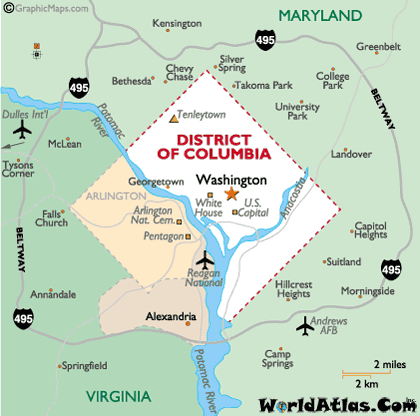
Washington, D.C. Retrocession and a Brief History of the City


The health care buzz has returned to Washington after a month and a half lull following the Senate’s passage of their health care bill on Christmas Eve. As we roll out of February I figured we’d “March” on into some Washington, D.C. history to show you that partisan politics and young professionals aren’t the only trademark of the city…

Thanks, but no thanks Virginia. Maryland will do

First off, Washington, D.C. has a very unique history. Unlike major metropolises that sprung up in colonial America, such as Philadelphia and New York, Washington, D.C. did not exist even in thought until 1787. The District of Columbia, or as it was known then, Federal City, was actually created in theory by the U.S. Constitution in Article 1, Section 8: “[The Legislative branch shall have the power] to exercise exclusive Legislation in all Cases whatsoever, over such District (not exceeding ten Miles square) as may, by Cession of particular States, and the acceptance of Congress, become the Seat of the Government of the United States.” The states that the Constitution speaks of end up being Maryland and Virginia, the two states straddling the Potomac River. Many may ask, why is Washington, D.C. where it is? Why isn’t it in the middle of the country? Why didn’t the founders use an existing city like New York?

There are several answers. First, D.C. was in the middle of the country. It is pretty much smack dab in the middle of the 13 original colonies. It also lies on a major waterway, which was a huge source of transportation and commerce. James Madison also argued that a new city was needed for security reasons to avoid mob riots in existing cities. Also, before there was anything built on the swampland that became Washington, D.C., New York City was the capital of the country. It was not until 1800, under the presidency of John Adams that any branch of government moved into the new city. The founders desired the country’s capital to lie on new ground, free from the existing culture of any one particular city. Finally, Washington is a unique city because it was built top-down, rather than bottom-up. That is to say, Washington was designed and laid out in 1791 pretty much exactly how it looks today… except that it’s missing the original southern half…

Which leads me to the retrocession. I am going to do this in timeline format so it is easier to follow:

1787-1791: A federal city is mentioned in the Constitution and remains a pretty sweet idea until G. Dubs (not Bush, George Washington in case there’s any confusion) pulled a Kennedy and said “by the end of this decade, I want a man on the moon.” … err I mean, “I want a place for all branches of government to conduct business.” Washington hires (and then fires) Pierre L’Enfant as the primary architect of the city.

1793-1800: Construction. In 1793, Washington laid the cornerstone of the Capitol building. (Side note: “Capitol Hill” and the Capitol building itself are some of the very few correct ways to use this spelling. Jefferson used this spelling in reference to the Capitoline Hill, which was the seat of the ancient Roman Senate). Maryland and Virginia both voted to cede land to create the District of Columbia. It is important to note that originally there were several separate entities: the city of Washington (downtown federal center), the county of Washington (MD area north of the river), the county of Alexandria (VA area south of the river), and Georgetown. Georgetown existed as an establishment before the creation of the District, therefore it remained its own locale until 1871.

1800-1845: Washington City within the District of Columbia became the center of government with the Capitol building (housing Congress and the Supreme Court) and the White House on the north side of the river. Consequently, Alexandria county to the south fell into a state of neglect. Unhappy with their conditions, residents in this area protested for action to be taken.

1846: Action was taken. Congress approved what is now called the Washington, D.C. retrocession of Virginia. In essence, all lands ceded by Virginia were given back to the state. The District ended the slave trade in 1850, while its neighbor across the river, Alexandria, now became slave territory.

1871: Congress passed the Organic Act of 1871 that merged Washington City, County, and Georgetown into one entity, the District of Columbia.

1961-present: The 23rd amendment to the Constitution FINALLY allows residents of D.C. to vote for president. Today, the quest for full voting rights and representation continues. Some proposals include using Washington, D.C. as a “congressional district” of Maryland for voting purposes, while still retaining its own self-government. Another suggests simply making it a 51st voting state, or even a retrocession of D.C. back to Maryland. Nothing has passed to date, and the debate rages on with D.C. residents donning the license plates “Taxation Without Representation.”


Saturday, February 20, 2010

The Olympic Games: Lee's Brief History


Well it’s Olympic time in the neighborhood again and I thought it would be appropriate to delve a little bit deeper into this acclaimed world sporting event. Thoughts? Well actually I guess you don’t have a choice on the topic, so read on!

Olympic History and Olympick History

As many of you know, the Olympic games held today are based on the similar event of ancient Greece. These Olympic games allegedly began in 776 B.C. in Olympia, Greece to pay homage to Zeus and the other gods who lived on Mt. Olympus, but also to bring together the Greek city-states in an event that would not result in a scene from the movie 300. Therefore the games were religious and political in nature. These events brought together free men from all over Greece, and eventually Italy after the rise of Rome to compete in athletic competitions. There were also games held for female athletes called the Heraea games, to honor Hera, the wife of Zeus, which began perhaps as early as 100 year after the start of the male Olympics.

Just like today, the games were a major international event that fostered pride for one’s hometown or region. Events ranged from discus throws, boxing, chariot racing, to the stade sprint race which was approximately 200 meters (originally measured in stades, which is where our English word “stadium” comes from. My Big, Fat, Greek Wedding is true, every word originates from Greek!). Another interesting tidbit is that the Greeks used an Olympiad (4 years) as a standard unit for measuring time. So, the games began in 776 B.C. therefore the famous battle of Thermopylae (from the movie 300) was held in the year of the 75th Olympiad (480 B.C.). The ancient Olympics continued even after the Roman occupation of Greece. Just before the beginning of the end for the Roman Empire, the Emperor Theodosius I disbanded the games in 393 A.D. because the collapse of Lehman Brothers and a $787 billion stimulus package put too much of a strain on their economy…. Ok so the real reason was because he believed the games were too “secular” and fostered the ancient pagan religion rather than his new adopted religion for the empire, Christianity. Much of what we know of the ancient Olympics comes from first-hand sources. One of the most important sources is Pausanius who was basically the Rick Steves of the classical period. In 175 A.D. he wrote a travel book of the Mediterranean area after visiting several historic sites in Greece, creating the basis for Lonely Planet today (slight exaggeration).

Skip ahead over 1000 years to 17th century England. Games were organized under the title of the Olympick Games on Cotswold Hill in Gloucestershire, England by a man named Robert Dover in 1612. These "games" were a series of competitions that mostly revolved around organized fights and brawls. For instance, in one of the early fights a man named Sir German Poole fought a Mr Hutchinson, of Gray’s Inn, during which Poole cut off three of Hutchinson’s fingers before he had even drawn his sword. In revenge Hutchinson sliced off Poole’s nose, picked it up, pocketed it and went off with it so that it could not be sewn on again. What?! Yep. So anyway, the Olympicks were suspended during the English Civil War, but were restored after the Restoration. The games were then disbanded again in the 19th century, only to be brought back in all their Olympick glory in 1963. Today, the games are more of a mixture of schoolboy fights on the playground, Scottish Highland Games, and Fight Club. The main attraction of the Olympicks today (aside from the massive consumption of alcohol) is the sport of shin-kicking. Yes, shin-kicking. Don’t believe me? Enjoy: http://www.youtube.com/watch?v=2iKcDNfIy7w

Right, so then we come to 1896, after 1500 years the Olympic Games return to Greece for the beginning of the modern Olympic Games in Athens. Winter Olympic sports were first added to the games during the 1924 games in Chamonix, France. Until 1992, there were held on the same year as the Summer Olympics, but in 1992 the Winter Games were changed to fall on an alternate schedule falling on even years.

So that pretty much brings you up-to-date with the Olympic Games today. Some things have changed. Athletes do not compete in the nude anymore, and are even allowed to wear outlandish pants that the fashion police should have caught, such as the Norwegian curling team. But many things remain the same: peaceful competition, strict punishments for cheating, and even the granting of citizenship to stellar athletes to allow them to compete for a different country (recorded by Pausanius in 175 A.D. and news media in the 2008 Beijing Games).

Last random Olympic factoid: The entrance of the Olympic torch to begin the games was started with the 1936 Games in Berlin. Leni Reifenstahl (who lived to be 101, dying in 2003), the renowned German filmmaker who created Triumph of the Will, was commissioned by Hitler to document the games to show the power and glory of Germany. In creating this cinematic masterpiece documentary called Olympia, she envisioned a dramatic start to the event. She came up with the idea of the Olympic Torch Run to accomplish this effect. The act of carrying a torch in to start the Olympic grounds has no factual basis from ancient history.